

Finding environmental justifications to deploy AI datacentres in countries around the world is now an established industry mechanism. Facing push-back from residents in those countries, worried about energy, water and heat impacts, the big -tech companies – and even more-so the developers seeking to hit pay-dirt in this modern digital gold rush – will line up no end of technology wizardry that shows local planning authorities that – whilst everyone else’s Datacentre is definitely a problem – theirs is state of the art, Green, in fact a genuine benefit to the environment and all around it.
In particular, claims keep surfacing in datacentre sustainability conversations: “closed-loop cooling, evaporative cooling, and adiabatic systems are environmentally low-impact” (at least, relative to conventional refrigerant-based cooling). Sometimes this is offered as a genuine efficiency argument. Increasingly, it's offered as an absolution — as if the choice of cooling mechanism determines how much energy a datacentre actually rejects into the environment.
It doesn't of course. Physics settled this question roughly two centuries ago, and it applies to a datacentre exactly as strictly as it applies to a steam engine.
AI might appear clever, but it hasn’t (yet) re-written the laws of thermodynamics.
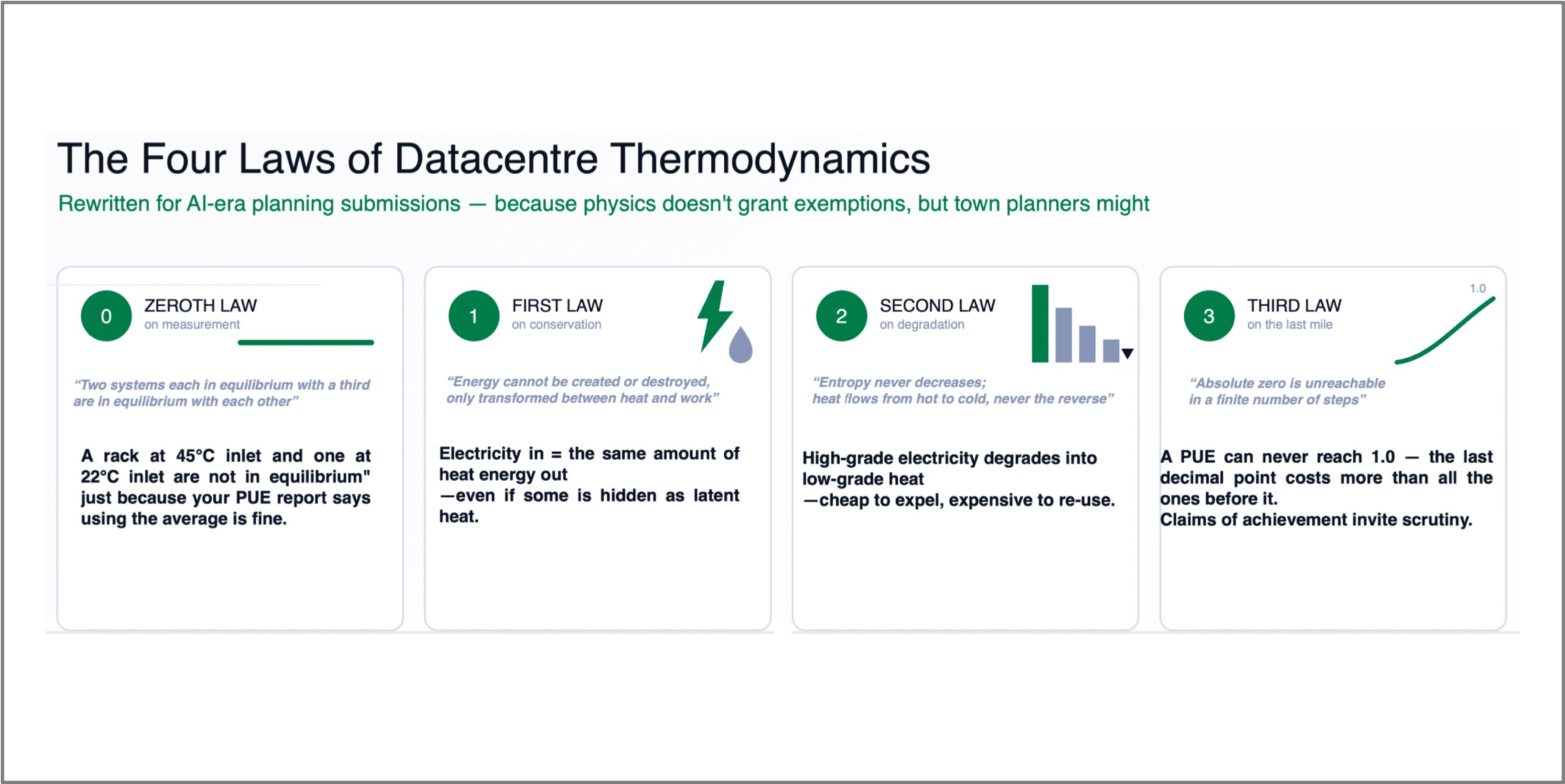
What follows are the four primary Laws of Thermodynamics, restated for the Datacentre estate, that procurement teams, regulators, and journalists should be using to interrogate every "sustainable cooling" claim put in front of them.
## Zeroth Law — On averaging away the problem
Classical Law: "If two systems are each in thermal equilibrium with a third, they are in equilibrium with each other — establishing temperature as an objective, comparable quantity".
**Datacentre Version: A rack at 45°C inlet and one at 22°C inlet are not "in equilibrium" just because your PUE report says using an average is fine.**
Facility-level averages are the easiest number to make look good and at the same time the least representative of what's actually happening at the hardware.
A site-wide PUE or average delta-T says almost nothing about whether specific racks are running hot, whether airflow containment has failed in one aisle, or whether your "average efficiency" is being bought at the cost of localised thermal stress.
Equilibrium is a claim about every part of a system, not the mean of it.
## First Law — On where the energy actually goes
Classical Law: "Energy cannot be created or destroyed, only transformed. For a system without matter transfer, internal energy changes according to the balance of heat and work crossing the boundary".
**Datacentre Version: Electricity in equals the same amount of heat energy out — even if some of it is hidden as latent heat.**
A datacentre performs essentially no thermodynamic work on its surroundings, or to put that in simpler terms:
it lifts nothing, launches nothing, retains no lasting mechanical energy.
This means that, in a steady state, nearly all of the electrical energy entering the site boundary will ultimstely leave as heat.
NOTE: Not most of it - practically all of it; and certainly more than 99%
This is where the cooling-method argument is used to quietly mislead planning officers and proposal evaluators.
-
Compressor-based cooling ejects the energy as ‘sensible heat’ — i.e. a measurable temperature rise in air or water, felt locally as an urban heat island effect or sometimes even a visible thermal discharge.
-
Evaporative and adiabatic cooling ejects the same joules of energy as ‘latent heat’: energy that is consumed converting liquid water to vapour, at roughly 2,260 kJ per kilogram.
This is a genuinely large number, and is exactly why evaporation cools so effectively; but that energy hasn't been destroyed or reduced. Physics doesn't let us off so easily.
That heat energy has simply been deferred and dispersed; moved into the environmental system to be released elsewhere, at some later point when that vapour condenses as cloud or rain, which may potentially be miles downwind of the facility that generated it.
Applied in high enough volumes this is how evaporative cooling can radically change environmental conditions over a massive area.
Both methods have an environmental impact - FACT.
The question is whether you want that effect to be strictly localised (compressor-based), or spread over a wider area* (evaporative), and an effect that's not felt locally is much easier to accept as a local planning official.
* Evaporative cooling affects the local area too - but through water resource use rather than localised heat: which means you can't just make the environmental impact someone else's problem.
When you apply evaporative cooling then just as before, that energy hasn't gone away.
In a feat of misdirection Kayser Söze would be proud of, its simply been moved elsewhere: it seems to disappear – but its billing address has just changed: it will pop up somewhere else later - that's how energy works.
## Second Law — On what "efficient" cooling actually trades away
Classical Law: "The entropy of an isolated system never decreases. Heat flows spontaneously from hot to cold, not the reverse, without external work".
**Datacentre Version: High-grade electricity degrades into low-grade heat — which is cheap to expel, but expensive to re-use for work.**
A datacentre converts a defined quantity of high-grade energy — i.e. grid electricity, genuinely capable of doing useful work — into a larger volume of low-grade heat, typically ejected at only 30–40°C.
This is exactly why waste-heat reuse schemes, such as district heating or greenhouse warming, remain exceptions rather than the norm: entropy this degraded is not cheap to un-spread so you can use it for real value purposes.
This is also where the real trade-off in the cooling debate sits - and it IS a trade-off - not a free win.
Compressor-based cooling costs more electricity, since mechanical work is needed to run the refrigeration cycle, but ejects its heat locally and visibly, with no net water loss.
Because there is mechanical work to be done the PUE is normally impacted.
Evaporative cooling costs less electricity, but ejects the same heat as water vapour, reducing the local thermal footprint while creating a different external pressure: a large net water consumption from the local watershed that doesn't return to that catchment area.
The PUE however is not impacted - the lack of mechanical work means you don't use electricity for colling = a lower PUE.
Both are legitimate engineering choices depending on site, climate, and grid carbon intensity, but neither is thermodynamically free.
Describing one as environmentally low-impact without explaining what resource was used to enable the energy management magic trick — usually trading heat for water use — is a conscious cynical omission, not a valid efficiency claim.
## Third Law — On PUE marketing
Classical Law: "As a system's temperature approaches absolute zero, its entropy approaches a minimum constant value, and absolute zero is unreachable in a finite number of steps".
**Datacentre Version: PUE can never reach 1.0 — the last decimal point costs more than all the ones before it. Claims of achievement approaching PUE 1.0 should thus invite increasing levels of scrutiny.**
Every fractional improvement toward a PUE of 1.0 costs disproportionately more than the last; in capital, in site-specific advantage such as free-cooling climates or immersion, and in engineering effort for diminishing thermal management returns.
This is however a genuine asymptote (a mathematical way of saying its not on a curve – its virtually a straight line : truth), and not just a marketing point.
A stated PUE closing in on 1.0 shouldn't be read as evidence of efficiency alone; not without also inviting the question of exactly how, where, measured over what period, and under what load that number has been calculated — because the physics says the closer that number gets to 1.0, the harder it should have been to get there.
When PUE’s of 1.1 or 1.2 are quoted, they need to be explained or evidenced – otherwise they ARE just marketing hyperbole.
A low PUE claim should sometimes be a red warning flag, not a green credential box to be ticked.
The question this stuff actually answers
None of the above should be read to say that evaporative cooling is the wrong choice, or conversely that compressor-based cooling is the right one.
It’s more a case of the question usually being asked — which cooling method has less environmental impact — is the wrong question because it implies one option avoids the impact rather than relocating it.
If you need to choose which heat management evil you want to accept: local heat islands or watershed water, we’d tentatively suggest the conversation went wrong a long way back.
A claim that cooling is basically environmentally free does not stack up— conservation of energy has already ruled it out.
The right question to ask is this:
How can we reduce the energy we use and the heat we generate in the first place?
If you want the answer to that question – come ask us.