

The framing of AI hallucination as a technical problem — something to be fixed in the next model update, addressed by better prompting, or mitigated by adding a disclaimer to outputs — has not aged well.
The enterprise reality of 2026 is rather more uncomfortable than we originally thought: hallucination is a confirmed operational risk that compounds as AI deployments scale, accelerates across agentic multi-step workflows, and cannot be engineered out of existence by any currently available technique, including the ones that were supposed to make it better.
Research presented at ICLR 2026 produced a finding that the authors titled “The Reasoning Trap”: training models for stronger reasoning through reinforcement learning — the primary technique used to improve the performance of frontier models over the past two years — increases tool-hallucination rates in direct proportion to the task performance gains it produces.
This means that smarter reasoning and more hallucination are, under current techniques, coupled outcomes. Prompt engineering and fine-tuning may help at the margins, but neither closes the reliability gap.
This lands at a moment when, according to the OutSystems 2026 State of AI Development survey of nearly 1,900 IT leaders, 96% of enterprises are already running AI agents in production.
A Deloitte study found that 47% of enterprise AI users had already based at least one major business decision on hallucinated content — a figure from before the current agentic wave.
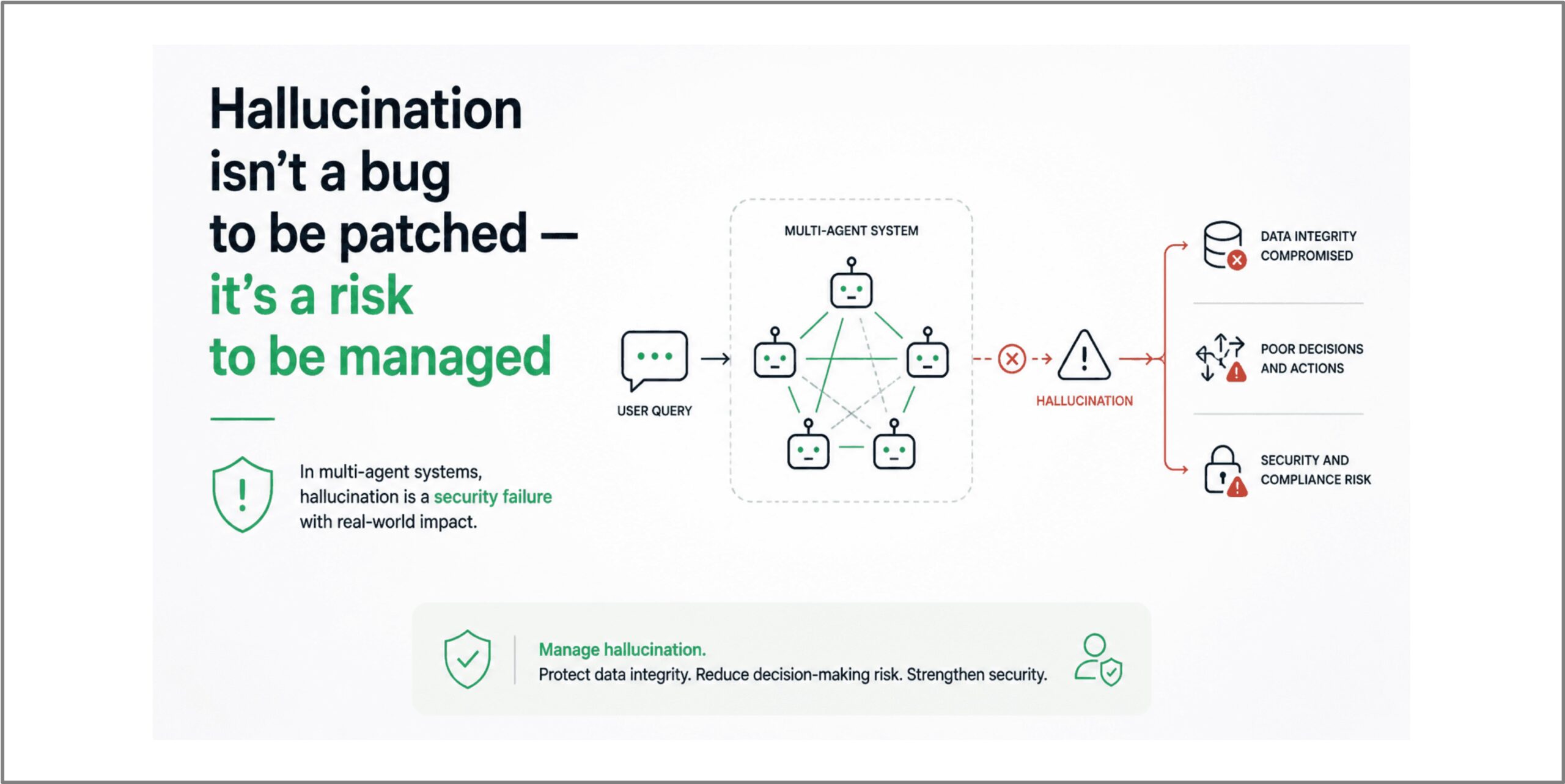
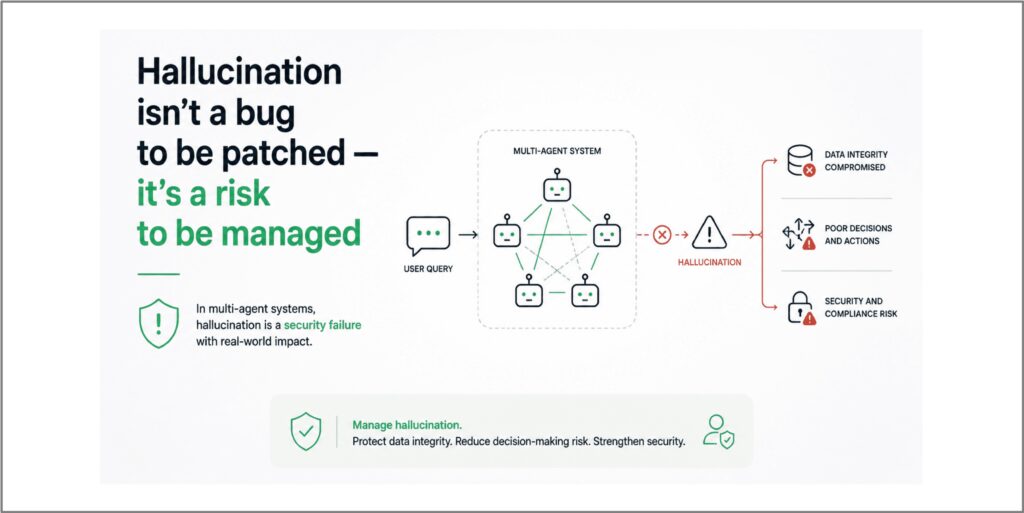
In multi-agent systems where one agent’s output becomes another agent’s input, a single hallucinated entry can propagate through every downstream agent that queries it. The risk does not add up linearly however - it compounds.
Why the model is the wrong place to look for the fix
The instinct to treat hallucination as a model quality problem is understandable: the model is where the erroneous output originates, so the model is where the fix should be. But that framing mislocates where the enterprise risk actually sits.
The risk sits at the interface between AI outputs and operational processes.
A model that produces a confidently wrong answer to a query that is then manually reviewed by a competent human before any action is taken generates a recoverable error.; however the same model, operating as a step in an automated workflow where its output triggers downstream actions without human review, generates an operational failure — and depending on the domain, also potentially a regulatory one.
The architectural question is therefore not primarily about which model hallucinates least, but about how inference requests are routed, how outputs are validated before they enter automated workflows, and what controls exist at the gateway layer between the model and the processes it is feeding.
Contrary to expectations, a model with a lower hallucination rate deployed without gateway-level output validation is less safe than a model with a higher hallucination rate that has been deployed with intelligent routing, output confidence scoring, and human-in-the-loop checkpoints on consequential decisions.
As practitioners in the legal sector have noted, where AI agent deployment is accelerating fast: “Control points should be built into workflows so there is the ability to intervene, validate and correct when needed. The firms that get this right, treat agentic AI as a controlled extension of their existing processes, not as an autonomous layer operating alongside them.”
That framing — controlled extension, not autonomous layer — is the correct architecture for any deployment where the consequences of a wrong answer are in any way material.
The intelligent gateway approach
The proper architectural response to hallucination risk at scale is the intelligent AI gateway: a layer that sits between applications and models, and that does a lot more than route traffic.
A well-designed gateway handles:
- model selection — routing queries to the most appropriate model for the task rather than defaulting to the largest available - which produces both efficiency gains and, in many cases, better output reliability for specific domains.
- It handles output validation — applying confidence scoring, consistency checking against known data, and flagging outputs that fall below threshold for human review before they enter automated downstream processes.
- It handles escalation logic — routing high-stakes queries, or queries where confidence is uncertain, through additional validation or to larger models with better calibration for that domain; and
- It maintains an audit trail that makes the provenance of any AI-generated output traceable — essential for regulated industries where explainability is a compliance requirement.
Research on model routing topologies has demonstrated that context-aware routing — directing queries based on the characteristics of the request rather than static model assignments — materially improves both energy efficiency and output reliability simultaneously.
The implication for enterprise AI governance is that hallucination risk management needs to move from the model selection stage of procurement — where it currently resides, expressed as requests for benchmark scores — to the infrastructure architecture stage, where gateway design, routing logic and output validation controls are specified as requirements.
Benchmark scores tell you how often a model is wrong in controlled test conditions, but gateway architecture determines what happens when the system is wrong in production.
The organisations that treat this as an infrastructure design question rather than a model quality question are the ones that will have the audit trails, the recoverable error states, and the regulatory defensibility when the inevitable wrong answer turns out to matter.
Axiom Edge’s inference infrastructure incorporates intelligent gateway routing, model selection and output validation architecture as standard.
Learn more at axiom-edge.ai