
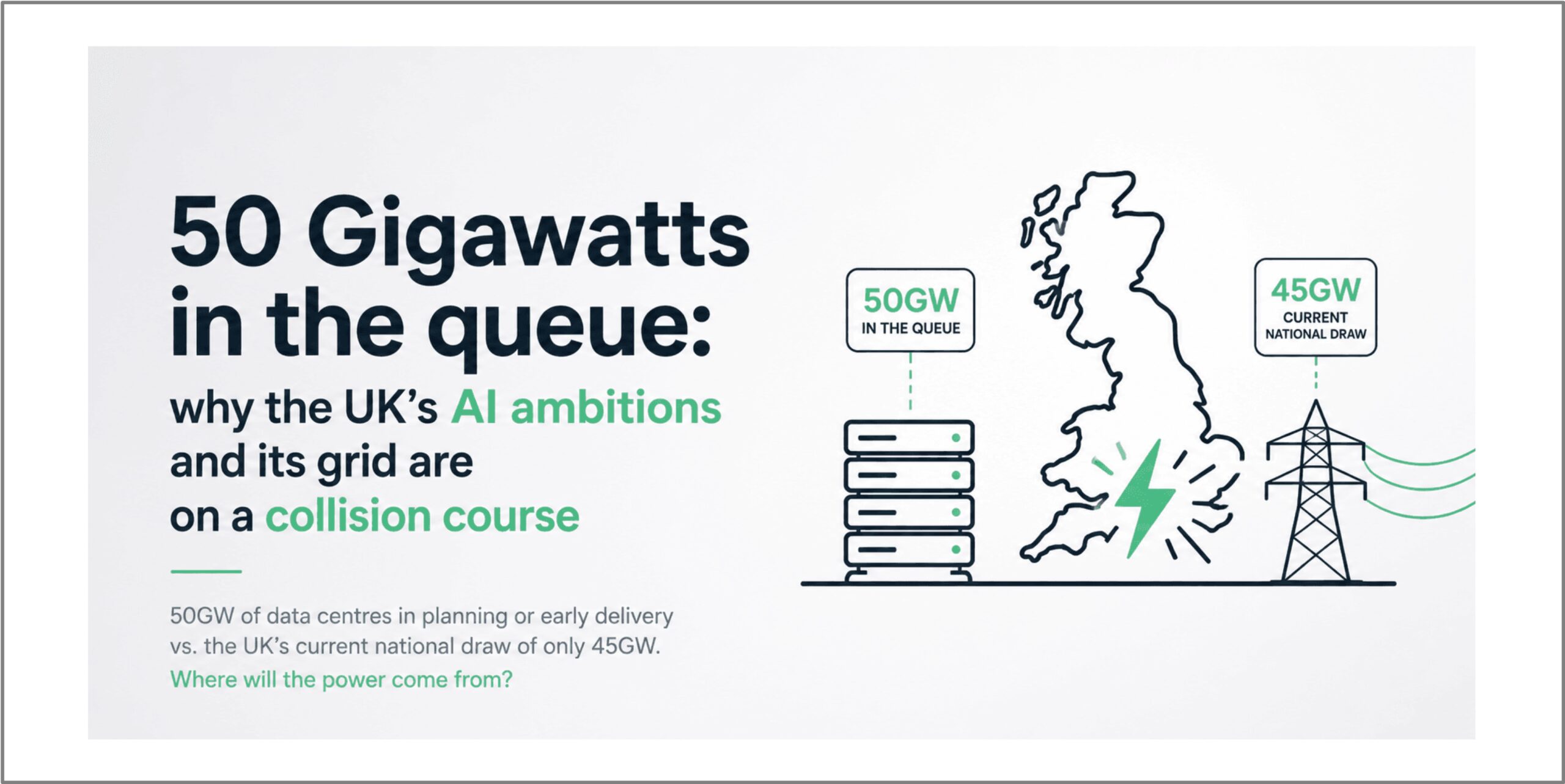



In February 2026, Ofgem published a number that stopped the data centre industry in its tracks:
More than 140 proposed AI data centre schemes had applied for grid connections with a combined peak demand of 50 gigawatts, whereas peak electricity demand across the whole of Great Britain on 11 February 2026 — the same month the figure was disclosed — was just 45 gigawatts.
Putting this in the simplest of possible terms - The proposed AI infrastructure, if built and operated at full capacity, would consume more electricity than the entire rest of the country combined.
This is a physical constraint with a concrete timescale for that limit to be hit.
The total capacity of contracted connection offers in the demand queue rose from 41GW in November 2024 to 125GW by June 2025 — a tripling in seven months.
This led Ofgem to assess that the volume of requests “exceeds even the most ambitious demand forecasts.” In response to its findings, the regulator has launched a formal consultation and reform programme, and has warned explicitly that unmanaged growth in speculative applications is already delaying connections for viable projects, jeopardising the government’s own AI Growth Zones programme, and threatening the UK’s 2030 clean power targets.
The proposed UK datacentre capacity is, according to The Times, approximately five times higher than what had previously been assumed in government planning tied to those targets. That gap — between what the government has been planning for and what the industry is actually building — is the collision course the headline describes.
How the queue got here
The connection queue crisis is not the result of a single policy decision, or a single company’s ambition. It's the compounded effect of the UK government’s active strategy to position Britain as a global AI superpower — attracting hyperscaler investment, announcing AI Growth Zones, and welcoming data centre development — running directly into the physical reality of an electricity network that was not designed for this type of load profile and cannot be upgraded on the timescale that AI infrastructure development is moving.
Ofgem has identified three structural failures in the current system:
- a rapidly expanding queue containing a significant number of non-viable or speculative schemes;
- delays for well-progressed projects caused by network build times and the volume of applications ahead of them; and
- the absence of any mechanism to prioritise strategically important developments over speculative ones.
The regulator’s proposed remedies are a Curate, Plan, and Connect framework, stricter financial and readiness tests for connection applications (including refundable deposits linked to delivery milestones, evidence of secured financing, and outline planning permission as an entry condition), and the possibility of allowing developers to build their own high-voltage grid access rather than waiting for National Grid.
These are reasonable responses to the immediate queue management problem, but they do not address the underlying tension between the scale of AI infrastructure demand and the capacity of the grid to serve it.
Nor do they properly explain how a falling UK generation capacity - with 85% of the country's aging Nuclear generation estate going offline by 2030 with no immediate replacement - can meet an increase in supply.
(The most likely answer BTW is to increase electricity imports, but even those connections may not be enough to meet all demand).
The government’s contradictory position
What makes this situation politically uncomfortable is that the UK government is simultaneously the author of the demand and the body responsible for managing its consequences.
The AI Opportunities Action Plan, published in January 2026, set out an ambition to make Britain a global AI leader, attract significant inward investment in compute infrastructure, and establish AI Growth Zones to accelerate data centre development.
The same government is responsible for the 2030 clean power targets that the data centre buildout now threatens; and the same government’s DSIT, as we noted in an earlier post in this series, has recently advised public sector technology buyers that they “may need to use cloud and software-as-a-service solutions outside of the UK” because non-UK services can be more cost effective. Not exactly the picture of a potential AI powerhouse...
The internal contradictions are not subtle, but thus far seem to be being studiously ignored. Encouraging the construction of data centres that would collectively exceed national peak demand, whilst simultaneously pursuing decarbonisation targets that depend on managed grid load growth, whilst concurrently directing public sector AI workloads to seek services from offshore, is not a coherent strategy.
It is two separate policy objectives that have not been reconciled with each other, or with the physical capacity of the electricity network, plus a short-term coping strategy.
A letter from climate scientists and engineers, cited in the E&T Magazine coverage of Ofgem’s consultation, warned that the energy required by proposed AI infrastructure poses a “serious threat to efforts to decarbonise the electricity grid” and called for datacentre developers to demonstrate that their projects will not cause an increase in the UK’s overall carbon emissions or local water scarcity as part of any forthcoming national policy statement on data centres. That is a reasonable minimum requirement, but is not currently a condition of grid connection applications.
Efficient AI infrastructure is part of the answer, not part of the wider AI problem
The framing of AI infrastructure as inherently grid-threatening is understandable given the numbers most people see, but it's an incomplete picture. It only describes a specific architectural approach — large-scale, always-on, power-hungry GPU arrays running at maximum throughput — as if it were the only model for AI infrastructure deployment.
Whilst this is the model being bought into by most Government agencies and planners, it's no longer the only way to develop high performance AI inference at national scale..
A conventional AI GPU rack can now draw 150 kilowatts (kW) or more under load. At the same time however, inference-optimised infrastructure built around energy efficient hardware and intelligent routing, can operate at a fraction of that draw for the equivalent inference output.
As we set out in our post on tokens-per-watt and our post on intelligent inference routing, the efficiency gap between a default-to-largest-model deployment and one built around right-sized model selection and context-aware routing is substantial: 27% or more in energy consumption for equivalent inference throughput, with further gains available from routing topology design. These are not theoretical projections, they are achievable with proven production infrastructure and AI accelerator cards from major vendors available right now.
The grid connection queue crisis is, in part, a consequence of an industry that has not yet accepted energy efficiency as a design constraint. Speculative data centre schemes applying for 50GW of grid connections are, by definition, planning for increasingly power-hungry architectures.
by contrast, schemes designed around efficient inference infrastructure — with a maximum draw of 23.1kW for a full AI and cloud converged rack rather than 150kW or more for a conventional GPU rack — have a fundamentally different grid and deployment footprint.
They fit into existing facilities, use standard cooling infrastructure, can be widely distributed to level load, and do not require the multi-year grid connection queues that are currently blocking development.
Ofgem’s proposed reform framework includes, notably, the possibility of prioritising connection applications that are aligned with national strategic energy plans and “starter provisions” for modular data centres that can energise in stages rather than waiting for full build-out.
Both of these provisions favour efficient, modular, right-sized infrastructure over speculative large-scale schemes - but are the Government listening to their regulator and will they invest in them?
Regardless, for organisations building AI infrastructure now, the regulatory direction of travel is toward deployments that can demonstrate grid compatibility, not just compute capacity.
The UK’s AI ambitions are real and the investment case for building domestic AI capability is sound. The grid and generation capacity constraints are however equally real and will not be resolved by optimistic demand forecasting.
The organisations and programmes that navigate this collision course successfully will be the ones that treat energy efficiency as an architectural requirement from the start — not as a sustainability report metric, applied retrospectively to infrastructure that was simply designed to consume as much power as the grid will permit.
Axiom Edge’s infrastructure draws 23.1kW maximum for a full AI and cloud converged deployment. That's not a constraint you need to work around, because it's the design target we chose to build it to.
Axiom Edge is a sovereign AI inference and cloud provider. Our infrastructure is designed for deployment within standard power envelopes